Barrel, Igloo, Modern or Square — Which Outdoor Sauna Should You Choose?
An outdoor sauna is a building, not an appliance — you will live with its shape, its heating and its footprint for fifteen years or more. This guide compares the four shapes we build most often, explains where each one genuinely wins, and covers the two decisions people usually get wrong: heating and size.
The four shapes, honestly compared
Every outdoor sauna heats the same way. The shape changes how fast it heats, how many people fit comfortably, and how it looks in your garden.
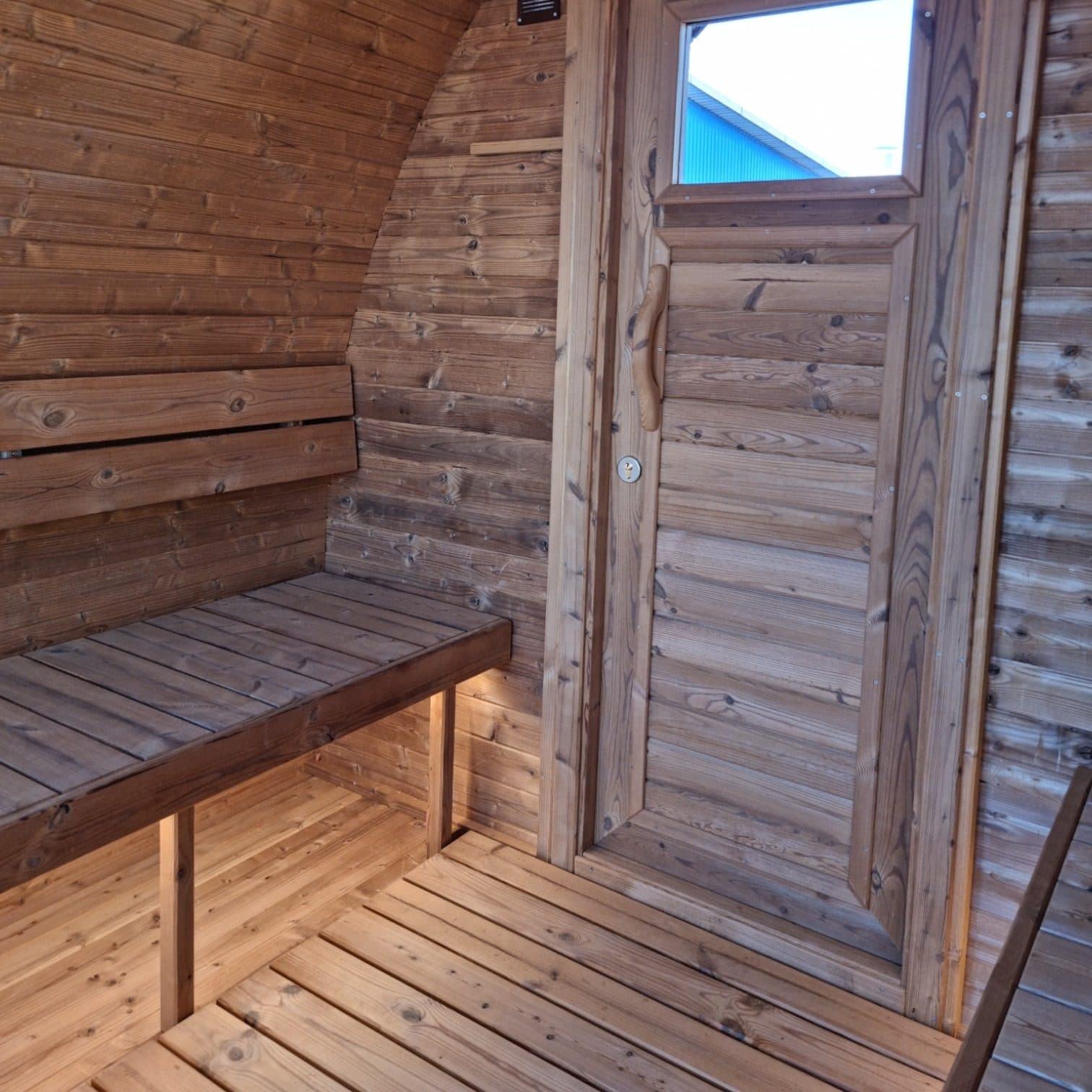
- Barrel — the classic. The round profile means less air volume to heat, so it warms up fastest and costs least to run. It is also the cheapest to buy. The curved walls make the interior feel snug rather than spacious.
- Igloo — a barrel with a panoramic glass end. You get the same efficient round shape plus a real view; with a 100% panoramic front it becomes the centrepiece of the garden. Costs more than a plain barrel because of the glazing.
- Modern — straight walls, flat or hidden roof, full-height glass. The most architectural option, and the easiest to fit next to a contemporary house. Straight walls give more usable bench space than a barrel of the same length.
- Square — the most space per metre of length. Vertical walls mean you can stand up anywhere inside, and the layout allows a proper changing room. The largest air volume, so it needs the most heating power.
If you want the cheapest good sauna, choose a barrel. If you want a view, choose an igloo. If you want it to look like part of the house, choose modern or square.
Wood-fired or electric — the decision that changes everything
This choice affects your ritual more than the shape does.
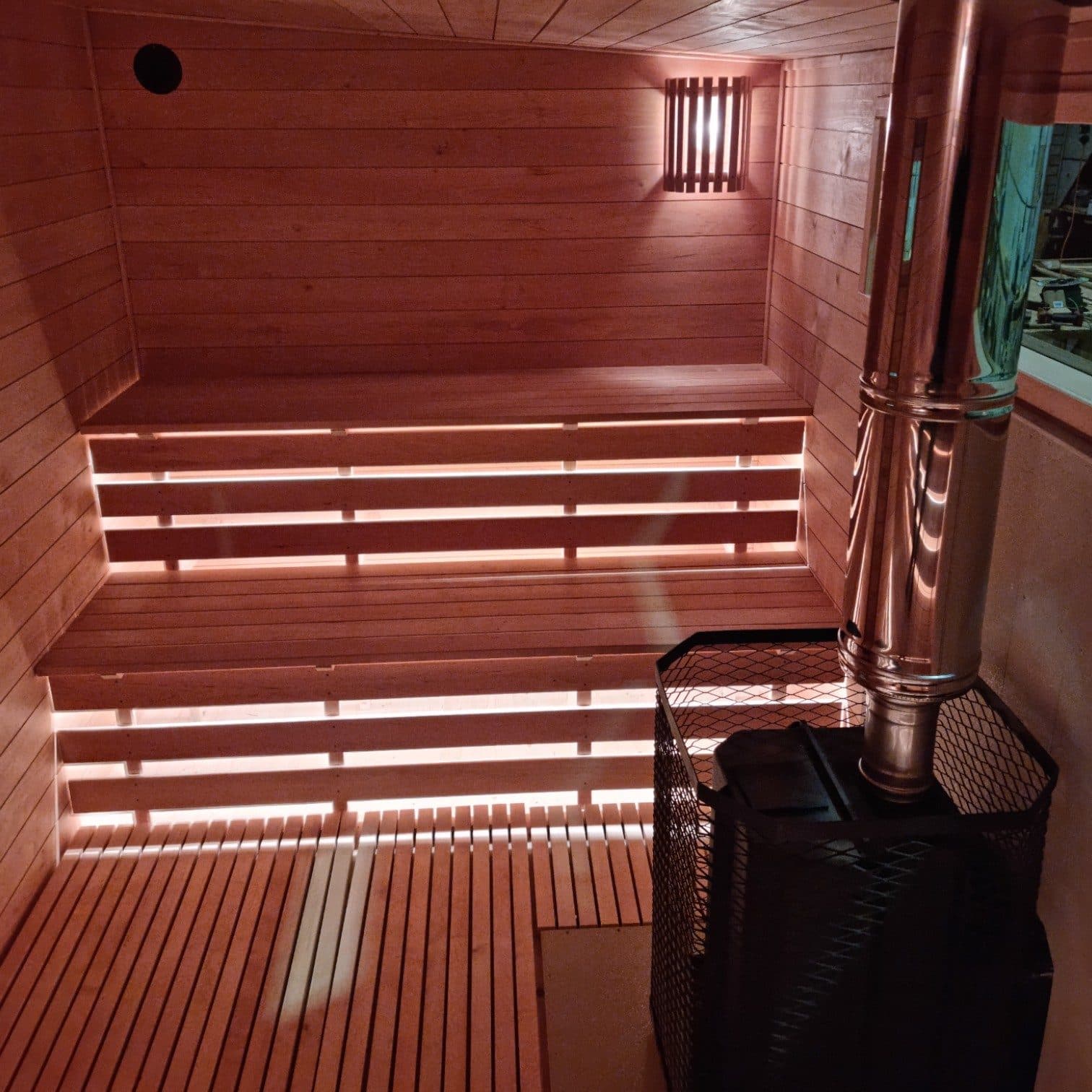
A wood-fired stove gives the sauna experience most people are actually chasing: the sound of the fire, softer heat, no electricity bill, and independence from mains power. It takes 45–90 minutes to reach temperature and needs tending. You also need somewhere to keep dry wood.
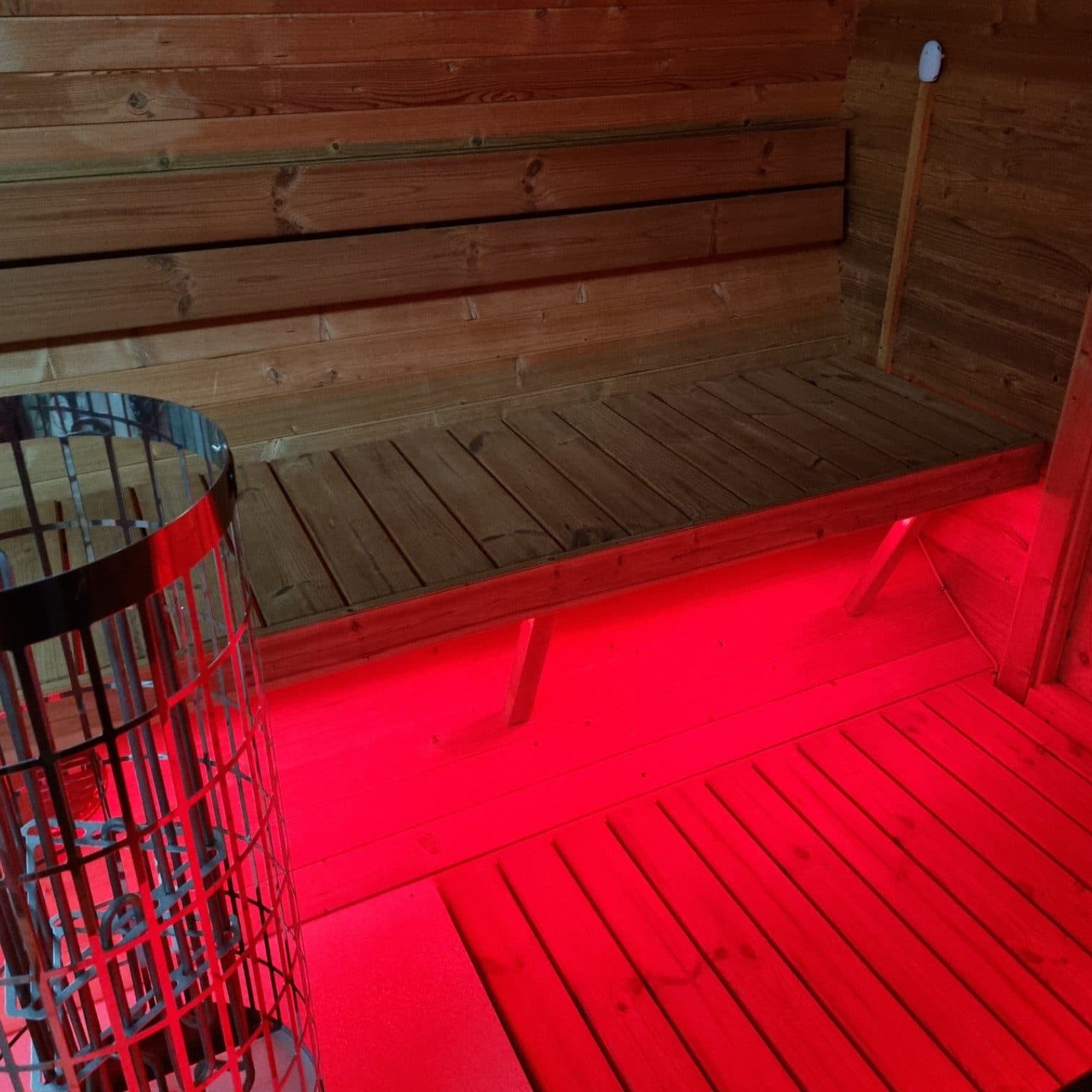
An electric heater is ready in 30–50 minutes, holds an exact temperature, and can be switched on from your phone with a WiFi controller — so the sauna is hot when you get home. It needs a proper three-phase connection for most sizes.
There is no wrong answer, but there is a common mistake: choosing electric for convenience and then discovering the cable run to the bottom of the garden costs more than the heater. Check the electrical connection before you decide.
If you cannot choose, some models take both — a wood stove for weekends and an electric heater for weekday evenings.
How big, really
Sauna size is quoted by external length. What matters is how many people can lie down, not how many can squeeze onto a bench.
- 2–2.5 m — two people sitting, one lying down. A private sauna for a couple. Cheapest to buy and to heat.
- 3–3.5 m — four people sitting, two lying down. The most popular size, and the one we would recommend to most families.
- 4 m — six people sitting, room for a small changing area or a bench for gear.
- 5–6 m — a proper sauna house: sauna room plus a separate changing or relaxation room. This is the size for regular guests.
The usual regret is buying too small. The difference between 3 m and 3.5 m is modest in price but decides whether two adults can lie down at the same time. The opposite regret exists too: a 6 m sauna heated for two people wastes wood and time every single session.
Materials and what they cost you later
The exterior cladding decides how much work the sauna needs from you.
- Spruce — the most affordable, light and traditional. Needs oiling or painting every couple of years to stay looking good.
- Thermowood — spruce or pine heat-treated without chemicals. Dimensionally stable, resistant to moisture and insects, and it ages to a calm grey if you leave it alone. The best balance of looks and low maintenance, and the most popular choice.
- Painted or burnt finishes — for a black modern look. Beautiful, and worth knowing that a dark facade in full sun weathers faster than untreated thermowood.
Inside, alder is the standard for benches and backrests: it stays cool to touch, does not resin, and does not splinter. Avoid softwood benches with visible knots.
The roof matters more than people expect. Bitumen shingle is the standard, and a hidden or extended roof edge protects the facade — which is what actually determines how the sauna looks after five winters.
Delivery, foundations and the first heat-up
We build the sauna complete in our workshop and deliver it fully assembled across Europe, so there is nothing to build on site. That has two practical consequences.
First, access. The sauna arrives on a trailer and needs to be lifted or rolled to its final position. Measure gateways, overhead cables and tight corners before ordering, and tell us about them — it is far cheaper to plan the approach than to solve it on delivery day.
Second, the base. The sauna does not need a concrete slab, but it does need a level, load-bearing surface: compacted gravel, paving slabs or concrete piers all work. A 3.5 m sauna weighs around a tonne empty. A base that settles unevenly will eventually make the door stick.
Before the first proper session, heat the sauna once at moderate temperature and ventilate it. This cures the stove coating and drives off the last of the moisture from the timber.
Frequently asked questions
Which outdoor sauna is the cheapest to own?
A wood-fired barrel sauna. The round shape has the least air volume to heat, wood is cheaper than electricity in most of Europe, and there is no electrical installation to pay for. A 2.5–3 m barrel in spruce is the lowest-cost route to a real sauna.
How long does an outdoor sauna take to heat up?
A wood-fired sauna reaches 80 °C in about 45–90 minutes depending on size, insulation and outside temperature. An electric heater of the right power takes 30–50 minutes. Winter adds roughly 15–20 minutes to both.
Can I use an outdoor sauna in winter?
Yes — winter is when it is best. An insulated sauna with a correctly sized heater works down to −25 °C and below. Keep the wood dry and clear snow from the roof and around the chimney.
Do I need planning permission for a garden sauna?
Rules differ by country and often by municipality. In much of Europe a small garden building under a certain floor area and height needs no permit, but distance to the boundary and to other buildings is regulated almost everywhere. Check with your local authority before ordering — especially for models over 15 m².
Is a 2-in-1 sauna and hot tub worth it compared with buying both separately?
It is worth it when space is limited or you want one delivery, one foundation and one connection instead of two. You also get the hot-and-cold ritual in a few steps. Buying separately gives you more freedom in placement and lets you spread the cost over two seasons.